Global sediment budget
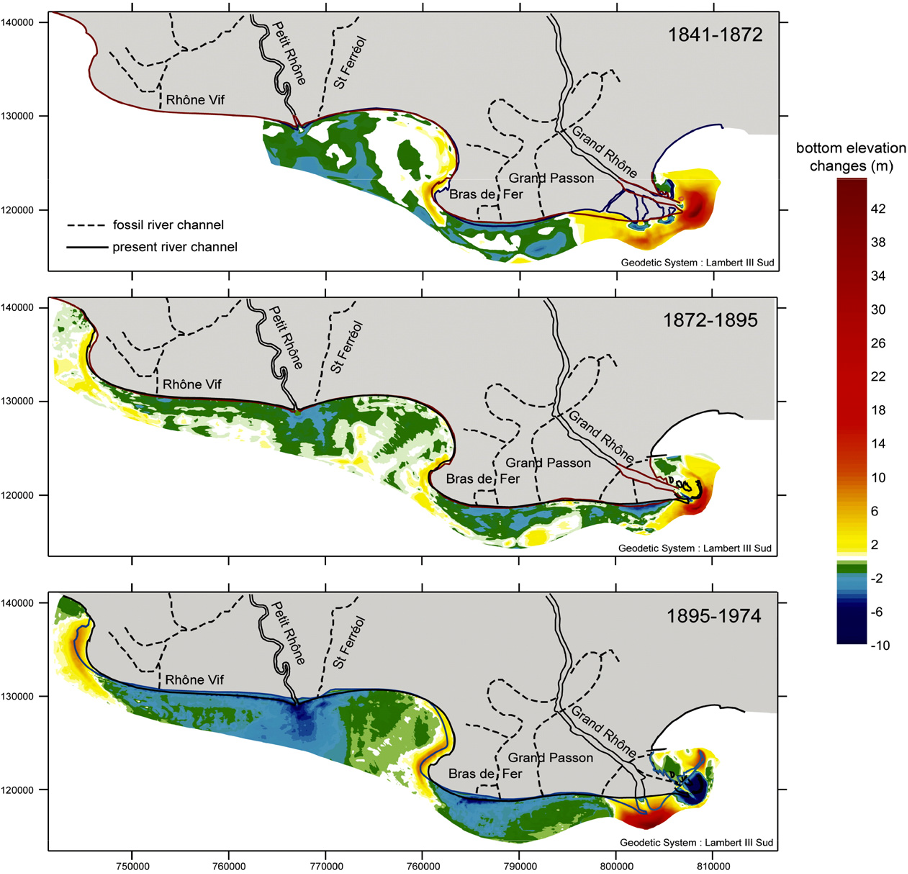
Bathymetric data reveal areas of deposition and erosion (Fig. 5). After river-mouth shifts, remaining mouths and prodeltaic lobes generally erode. The Petit Rhône prodeltaic lobe erodes continuously throughout the study period.
Bathymetric data reveal areas of deposition and erosion (Fig. 5). After river-mouth shifts, remaining mouths and prodeltaic lobes generally erode. The Petit Rhône prodeltaic lobe erodes continuously throughout the study period.
Since 1841, sediment has accumulated mainly in the Beauduc Gulf and along the Espiguette and Beauduc spits. The Gracieuse spit appeared in 1895. The Grand Rhône mouths form a sedimentary belt about 1.5 km wide.
Bathymetric data are available only for 1872–1895 and 1895–1974. Both periods show a positive overall sediment budget, but it decreases sharply from +11.10 to +1.47 × 10⁶ m³ yr⁻¹.
Changes in prodeltaic lobes
Net accumulation at the Grand Rhône lobes declines over time, from 12.63 to 3.40 × 10⁶ m³ yr⁻¹ between 1841–1872 and 1895–1974. Petit Rhône and offshore areas show increasing erosion, from −0.53 to −1.34 × 10⁶ m³ yr⁻¹.
All relict prodeltaic lobes erode once the river ceases to discharge. Erosion rates generally decrease over time, as seen in the Bras de Fer lobe. Piémanson and Roustan lobes eroded after artificial closure, stopping only after Roustan reopened in 1892. Westward mouth shifts subsequently caused erosion of the Pégoulier lobe.
Changes in the shoreface
The shoreface budget was calculated for the western Grand Rhône zone, dominated by waves. Eastern areas influenced by river input were excluded. Petit Rhône is included due to its erosional regime.
During the first period, the shoreface budget is positive (+2.73 × 10⁶ m³ yr⁻¹). In the second period, it becomes negative (−1.94 × 10⁶ m³ yr⁻¹). This change is due to increased erosion and decreased accumulation.
Upper shoreface (0–10 m) shows slight net accumulation initially (+0.34 × 10⁶ m³ yr⁻¹), then minor erosion (−0.28 × 10⁶ m³ yr⁻¹). Lower shoreface initially gains sediment (+2.39 × 10⁶ m³ yr⁻¹) but shifts to strong erosion (−1.66 × 10⁶ m³ yr⁻¹).
Overall, sediment accumulation has become more limited over time. Relict lobes and shoreface zones illustrate the combined influence of river-mouth dynamics and wave processes. The data show that shifts in river mouths directly affect prodeltaic lobes and the adjacent shoreface. Sediment supply from active mouths is crucial for maintaining deltaic accretion. Areas cut off from river input experience progressive erosion. Wave-dominated zones are particularly sensitive to long-term sediment redistribution.