Shoreline changes
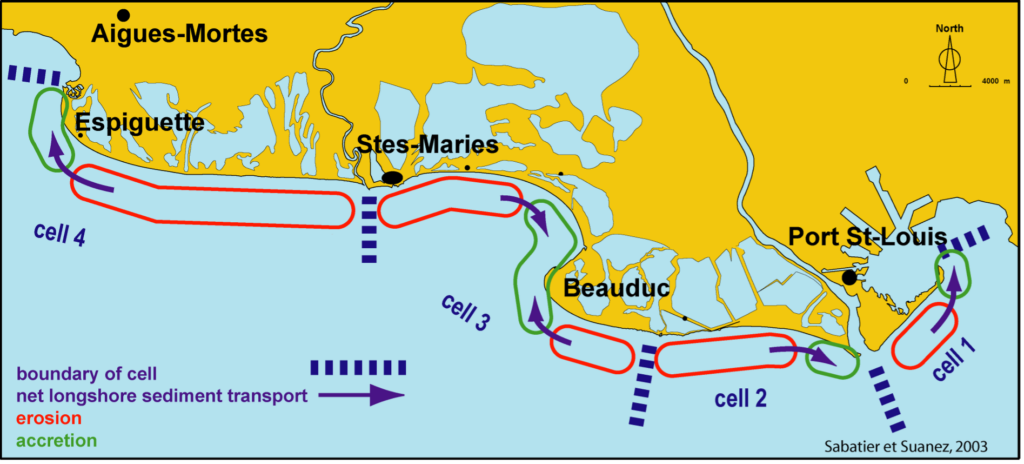
The longshore drift pattern is based on the identification of four cells, each of which is defined by an accretion zone (spits, gulf and Roustan mouth) supplied by a zone undergoing erosion (May and Tanner, 1973; Stapor, 1974; Carter, 1988; Komar, 1998). While longshore sediment transport is the major process reshaping the Rhône delta coastline, cross-shore processes also exist, but these cannot be quantified using shoreline change analysis. The cell definition pattern presented here is based on the pattern of evolution of the Rhône delta. However, it is confirmed by simulations of longshore sediment transport using empirical equations (Sogreah, 1995; Kulling, 2017).
The easternmost cell (CEL1) is located east of the Grand Rhône, where the prevailing sediment transport is eastward (fig. 1). It is bounded on its western side by the mouth of the Rhône, and on its eastern side by the La Gracieuse spit. This cell is thus fed by the present-day inputs of the Rhône (active source) and by the erosion of the fossil deltaïc lobe of Pégoulier (Suanez, 1997; Suanez et al., 1998).
The second cell (CEL2) also shows a general direction of transport from west to east, and extends from Ste-Anne lagoon as far as Grau de Roustan (fig. 1). Although the shoreline retreat in this zone contributes to the supply to Piémanson beach, part of the eroded material is stored in the vicinity of the Roustan prodelta, considered as an important sediment sink (Suanez et al., 1998) The limit between cells 2 and 3, located generally near Ste Anne lagoon, is explained by a reversal of the longshore drift along with sediment transport as a result of refraction of swell on the fossil deltaic lobe of the Bras de Fer (Sabatier, 2001).
The third cell 3 (CEL3) extends from Ste Anne lagoon in the east as far as the Petit Rhône in the west (fig. 1). This cell is made up of a central part subject to accumulation (spit and gulf of Beauduc), fed in the east by the retreat of the beaches and erosion of the fossil sub-delta of the Bras de Fer, and in the west by erosion of the beaches in the Saintes-Maries-de-la-Mer sector. Thus, drift convergence associated with the two eroded sectors results in an important sediment sink in the very centre of the delta. Sediment supply to Gulf of Beauduc via the Petit Rhône is extremely limited, being dependent on the very weak sand inputs of this arm (Arnaud-Fassetta, 1996, 1997; Arnaud-Fassetta et al., 2003).
To the west of the Petit Rhône, the fourth cell (CEL4) is defined by a dominant sediment transport directed towards Espiguette spit (fig. 1). As seen on the littoral of Faraman, the opposite sediment transport directions in cells 3 and 4 can be explained by the divergence of the longshore drift related to refraction of swell on the prodelta of the Petit Rhône (Sogreah, 1995; Sabatier, 2001). The sector in erosion from the Petit Rhône to Baronnets contributes to sandy inputs to the spit, which may also be considered as a sand sink (Blanc, 1977; Sabatier and Raivard, 2002).
Bathymetric changes
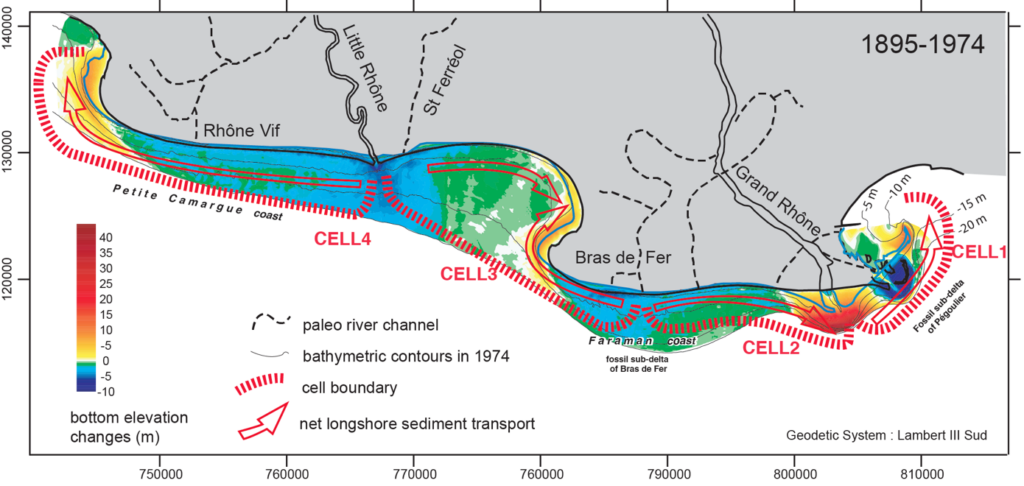
Comparison of Rhône delta shoreface bathymetry from 1895 to 1974 shows a clear pattern of erosion and accretion along the shoreline (Fig. 2). Relict sediments from the Little Rhône, St Férreol, Bras de Fer, and Pégoulier lobes are reworked shoreward to feed the growth of Espiguette, Beauduc, and Gracieuse spits, reflecting classic longshore drift cells. Cell 1, east of the Grand Rhône, is fed by Pégoulier lobe erosion, with the Rhône river contributing minimally (~30,000 m³/yr) compared to spit accumulation (~2,490,000 m³/yr). Cell 2 extends from Ste Anne lagoon to Grau de Roustan, with sediment partly stored in the Roustan prodelta. Cell 3, from Ste Anne to Little Rhône, accumulates sand in Beauduc spit and bay, sourced from east and west erosion zones, forming a central sediment sink. Sediment supply from the Little Rhône is very low. Cell 4, west of Little Rhône, directs sand toward Espiguette spit, but the shoreface shows a slightly negative budget (~−120,000 m³/yr) due to minimal river input and possible offshore losses. Beauduc spit gains ~600,000 m³/yr, balanced by erosion of the Bras de Fer lobe (~510,000 m³/yr). Overall, longshore redistribution governs sediment dynamics, while river input plays a minor role in non-adjacent cells. These results highlight the importance of relict lobe erosion and drift cell interactions in controlling spit growth and coastal evolution.