
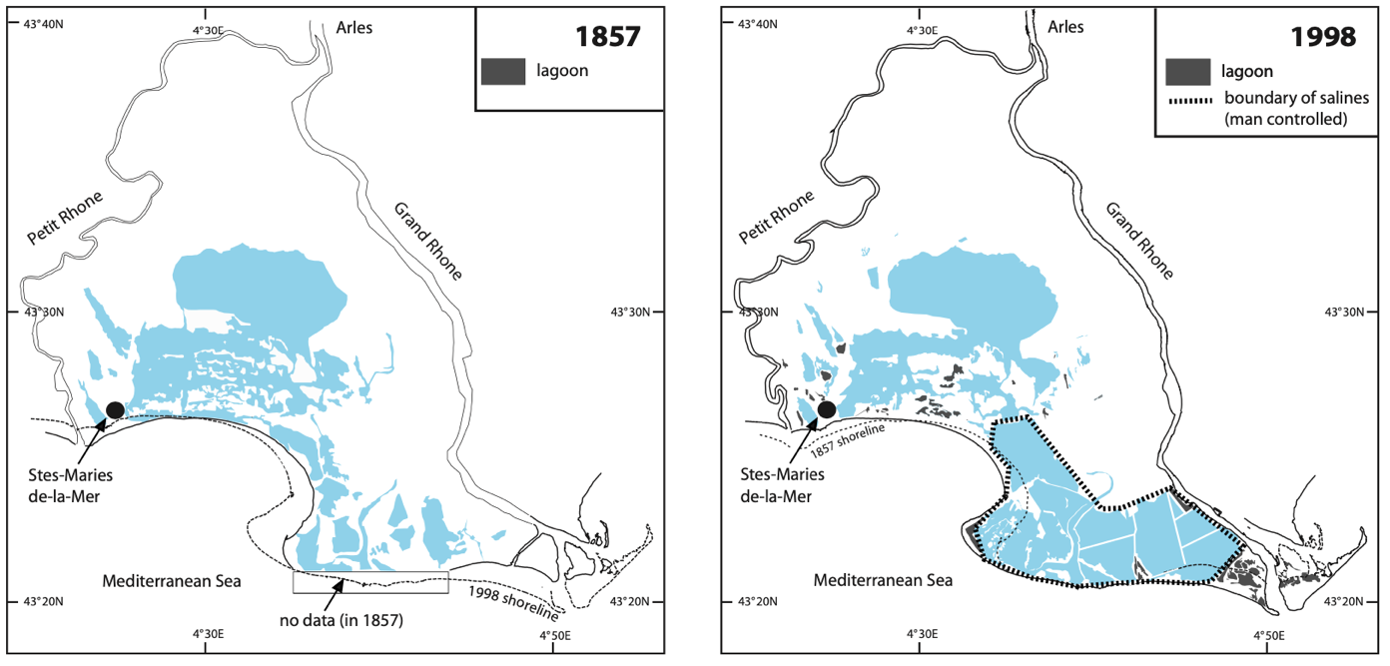
A common approach in coastal geomorphology for assessing the future evolution of littoral systems is to analyse their historical dynamics in order to understand their functioning and infer possible future trajectories (Paskoff, 1998). Within this framework, the evolution of lagoons and shoreline positions between 1857 and 1998 was examined (Fig 1). Over this period, sea level rose by at least 190 mm, based on measurements for 1905–1993 (Suanez, Prosper-Laget, and Provansal, 1997). Assuming a linear rate of rise, the total sea-level increase between 1857 and 1998 can be estimated at approximately 296 mm. If shoreline displacement is assumed to depend solely on sea-level rise, such an increase should have produced significant submergence of the Rhone delta plain. However, the 141-year comparison reveals contrasting shoreline responses: east–west oriented beaches retreated by up to 900 m, whereas the Beauduc spit advanced, the Rhone mouth prograded markedly, and the Gracieuse spit developed (Figure 1). These observations show that a sea-level-rise-only framework is insufficient to explain long-term shoreline evolution. In particular, sediment inputs associated with overwash deposits must be considered, as they contribute to vertical and lateral accretion and can offset the effects of rising sea level.
For the open beaches of Camargue, measured shoreline retreat (before hard engineering works) between 1895 and 1977 averages −3.4 m yr⁻¹, whereas retreat retreat (based on modified Brunn’s rules) estimated from relative sea-level rise (RSLR) is only −0.4 m yr⁻¹, indicating that Relative Sea Level Rise (RSLR) accounts for about 8 % of total (Fig 5 and 6). This low contribution highlights the minor role of sea-level rise compared with other factors. Zones of accretion show opposite trends, reflecting the dominant influence of longshore transport and littoral cell distribution. Maximum theoretical retreat from RSLR occurs in the Golfe de Beauduc, yet measured shoreline is advancing, emphasizing the key role of sediment redistribution alongshore. Sandy inputs from the Rhône are largely retained at the river mouth, with minimal contribution to distant beaches. Sediment supply has decreased in the 20th century due to reduced floods and dam construction.
In eroding areas, sea-level rise enhances retreat, while in accreting zones it limits shoreline advance. Morphodynamic flexibility allows beaches to migrate landward via overwash, increasing delta plain elevation and partially compensating for sea-level rise (Fig 7 and photos) . Hard coastal structures, especially seawalls, block overwash and prevent landward migration, leading to local beach loss, whereas groynes allow some natural sediment dynamics. Overall, longshore sediment transport gradients, limited redistribution of Rhône sands, and sea-level rise together control shoreline evolution, with future challenges focused on climate impacts on sediment supply and transport.
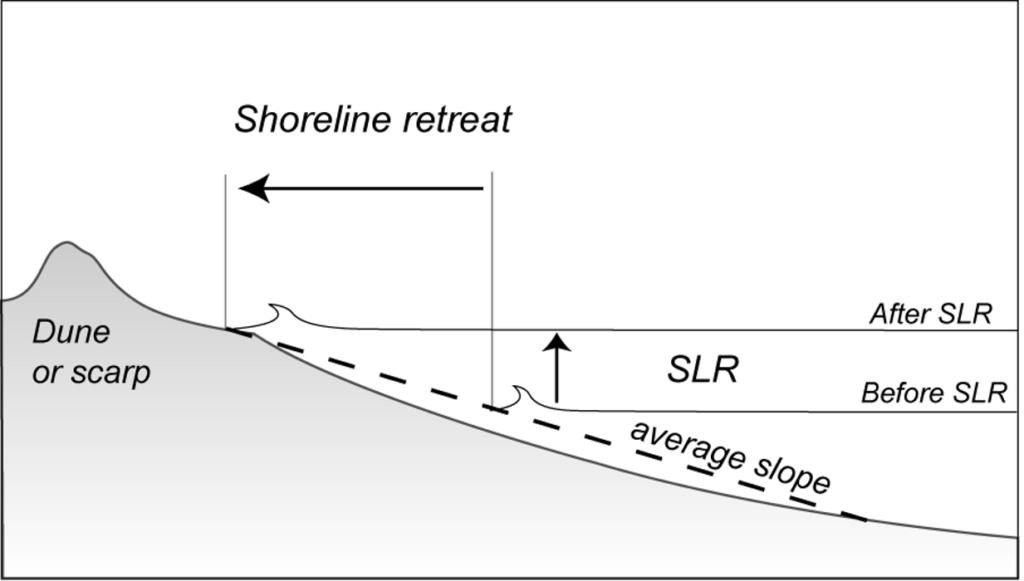
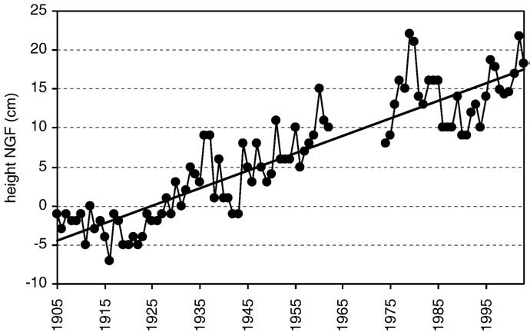 Fig 3. Sea level rise in Camargue (Sabatier et al., 2009)
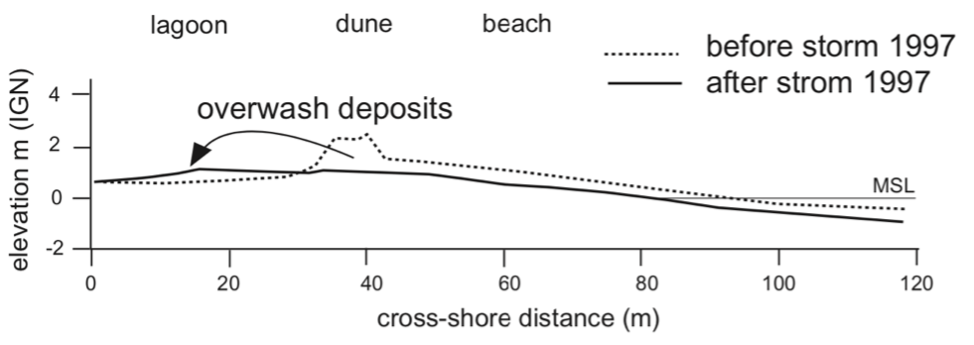 Fig 4a. Dépôts d’overwash en Camargue après la tempête centennale de décembre 1997 (Sabatier et al., 2005)
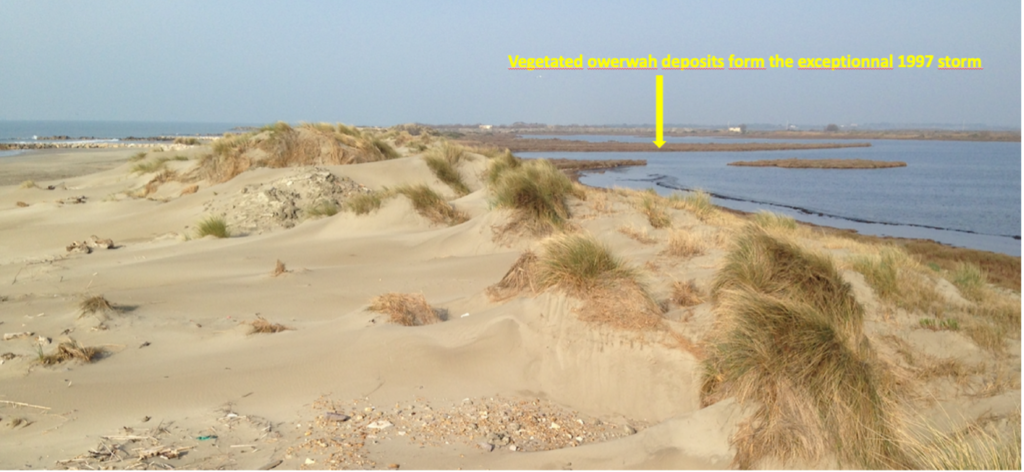 Fig 4b. Dépôts d’overwash en Camargue après la tempête centennale de décembre 1997 (Sabatier et al., 2005)
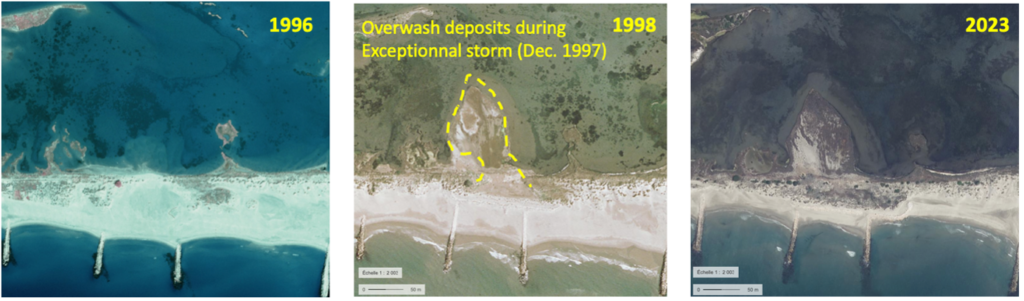 Fig 4b. Dépôts d’overwash en Camargue après la tempête centennale de décembre 1997 (Sabatier et al., 2005)