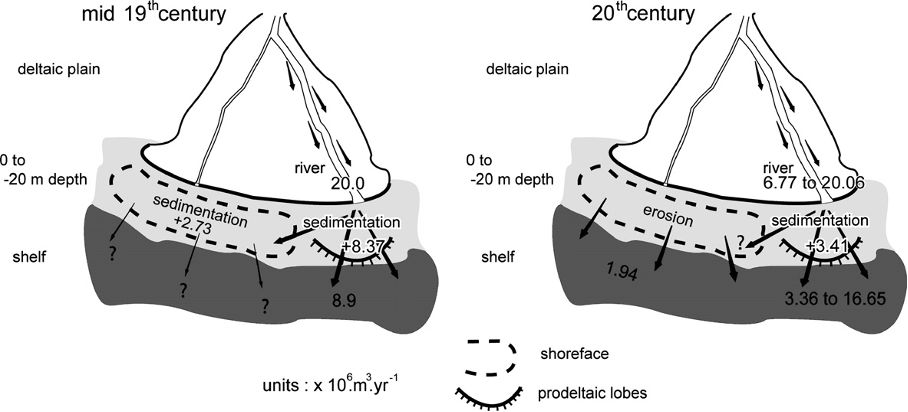
Connections between the river, active prodeltaic lobe, shoreface and shelf of the Rhône system
Based on our results and previous studies, a long-term sediment budget can be proposed for the Rhône river-mouth–shoreface–shelf system (Fig. 1). Estimating this budget requires quantifying the total river sediment input, including both bedload and suspended sediment transport, which are assumed to represent roughly 10 % and 90 % of total transport, respectively. Converting these fluxes to volume, and combining them with bathymetric changes in prodeltaic lobes and the shoreface, allows estimation of sediment bypass and delivery to the marine domain. Between the mid-19th and early 20th centuries, total sediment transport likely ranged from 19 to 22 × 10⁶ m³ yr⁻¹, with approximately 8.4 × 10⁶ m³ yr⁻¹ accumulating in the Grand Rhône prodeltaic lobes. Positive sediment budgets in the lower shoreface indicate that this zone directly received river sediment, while the upper shoreface remained near equilibrium. Offshore sediment transport was likely active during both the 19th and 20th centuries, although decreasing river discharge in the 20th century led to net offshore losses. Channel incision and human works facilitated downstream sediment delivery, while engineering interventions along the arms reduced deltaic plain sedimentation. Sediments are also deposited on the shelf, with both prodeltaic and shoreface contributions, forming a long-term source of offshore accumulation. Finally, these estimates represent orders of magnitude derived from bathymetric comparisons, reflecting combined effects of river discharge, wave action, and storm-driven sediment transport, similar to patterns observed in other deltaic systems.