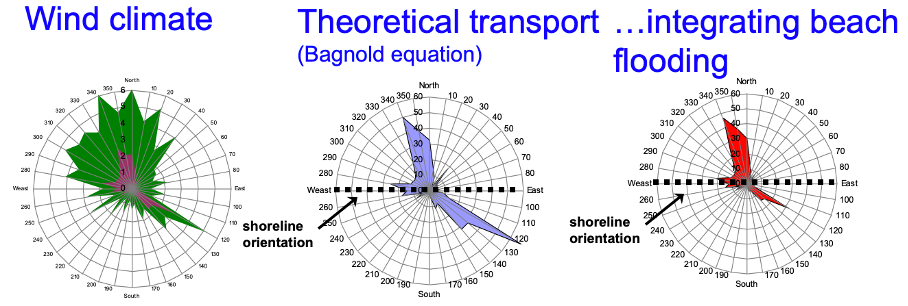
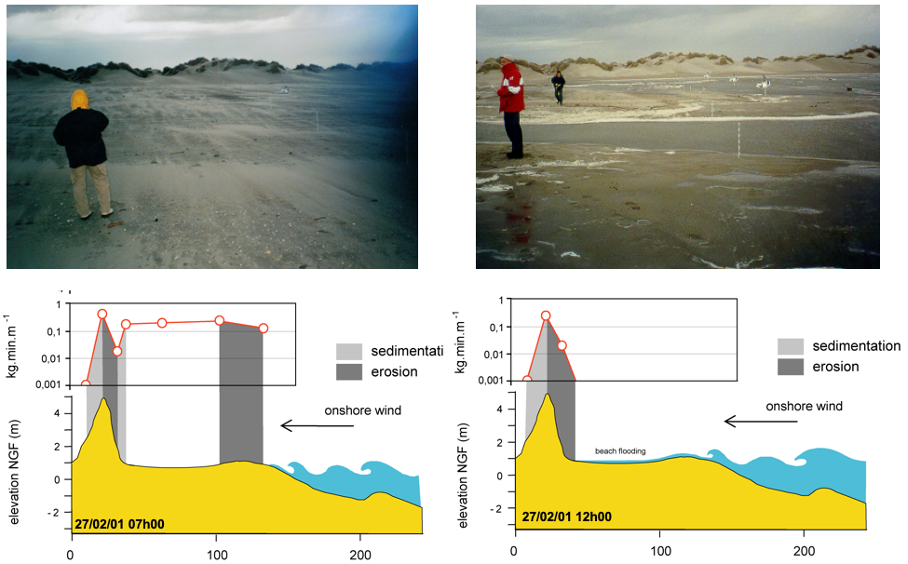
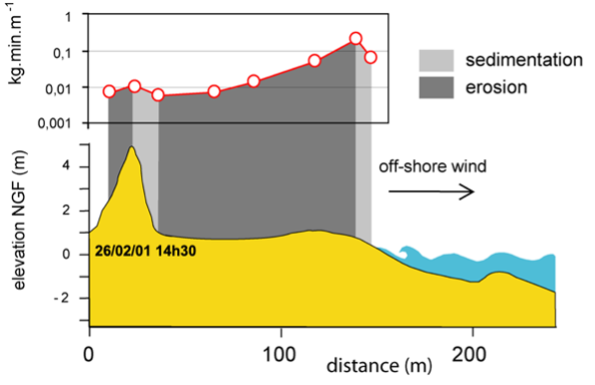
The Rhône delta shoreline is influenced by offshore winds from the N and NW (Mistral and Tramontane) and onshore winds from SSW to SE that generate storms (Fig. 1). Overall, potential aeolian transport is balanced between these wind sectors, but beach submersion and rainfall limit onshore transport (FIG 2), making N–NW winds more effective (Fig. 3).
Along straight, E–W eroding coasts, net aeolian transport is low, hindering dune formation. In curved spit sectors, orientation favors W–N winds, promoting significant sand transport over long dry fetches
Spit tips experience cross-shore transport from inner shores to central and seaward flanks, which act as temporary sand storage before transport to the sea. Using Fryberger’s aeolian drift concept (Fig. 1) and sand trap data, Gracieuse, Beauduc, and Espiguette spits lose approximately 12,000; 24,000; and 40,000 m³/year, respectively, to wind deflation. This sand is not lost but recycled locally via swash-induced beach accretion or moved alongshore to spit extremities. Shoreline orientation thus controls source and sink zones for aeolian sediment. Aeolian processes complement longshore drift and contribute to the dynamic morphodynamics of the Rhône delta spits. Overall, wind-driven transport plays a secondary but essential role in coastal sediment redistribution.