The litterature Review by Anthony et al., (2024) demonstrate how deltas have acted as environmental incubators for human civilization. Over the past 7,000 years, humans have progressively adapted to deltaic environments, forging a deeply interconnected relationship while also inducing profound biophysical alterations in these landscapes. Today, low- to mid-latitude deltas face increasing sediment starvation due to: Hydropower development (dams and reservoirs in river basins), Aggregate mining, and Accelerated subsidence from population growth and resource exploitation.
Without effective climate stabilization, the sustainability of densely populated low- to mid-latitude deltas will be increasingly difficult to preserve, potentially ending the delta–human symbiosis as we know it.
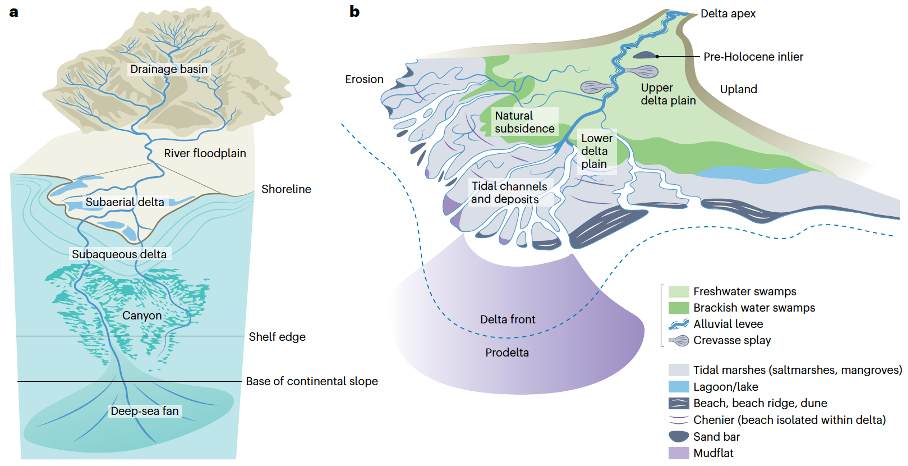
exceeding dispersal processes. This leads—particularly in large deltas—to the accumulation of substantial sediment masses both onshore and in the subaqueous zone^(9). The world’s largest deltas began developing around 8,000 years ago, spanning much of the Holocene epoch (the past 10,000 years of Earth’s history). Their existence has depended on a steady supply of sediment from river catchments.
b, Idealized delta dynamics. Deltas expand seaward and upward from initial bayhead settings, a process favored by relatively stable global sea levels. Most of the world’s deltas have a mean elevation of less than 2 meters above present mean sea level^(88), though precise elevation data remain limited. Deltas naturally subside due to sediment compaction, including organic matter, under their own weight. Ecologically diverse, deltas exhibit subtle elevation gradients and are prone to flooding, channel avulsions, meandering, storm-driven marine incursions, and localized erosion. Despite these hazards, deltas have historically provided space and resources for human societies to develop and thrive (Anthony et al., 2024)
The Mediterranean deltas
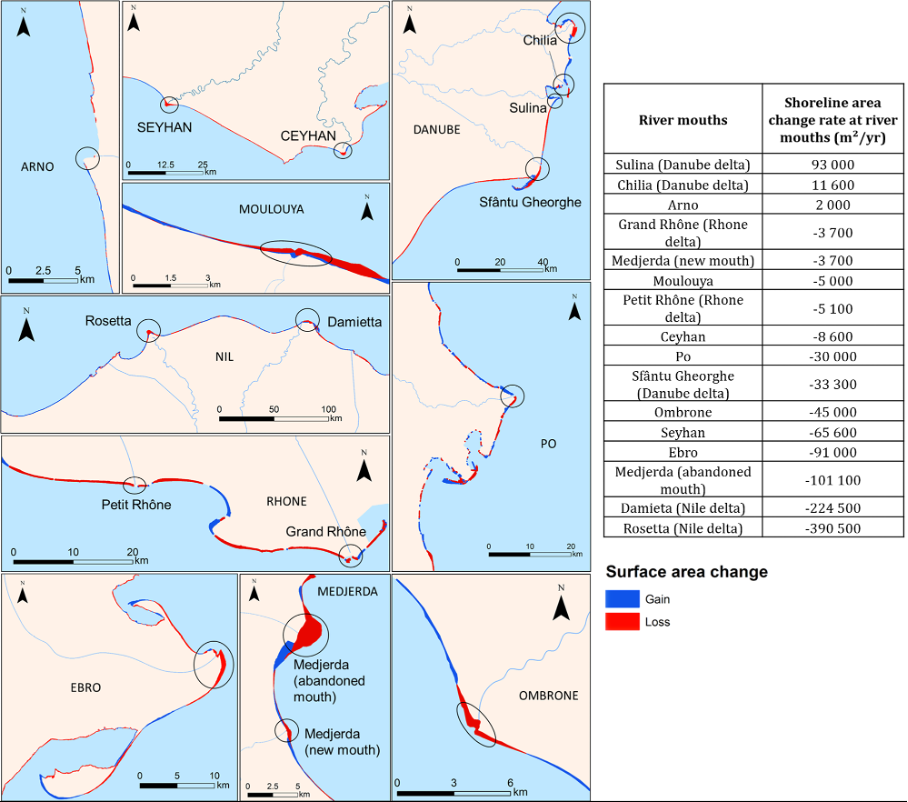
The Mediterranean basin (including the Black Sea) is characterized by a plethora of deltas that have developed in a wave-influenced setting. Many of these deltas are sourced in sediments by river catchments that have been variably dammed. The vulnerability status of a selection of ten deltas subject to different levels of reduction in fluvial sediment supply following damming was analysed by quantifying changes in delta protrusion area and protrusion angle over the last 30 years. The rationale for choosing these two metrics, which do not require tricky calculations of longshore bedload transport volumes and river ‘influence’, is that as sediment supply wanes, increasing relative efficiency of waves leads to longshore redistribution of reworked sediments and progressive ‘flattening’ of the delta protrusion. The results show that eight of the ten deltas (Nile, Rhône, Ebro, Ceyhan, Arno, Ombrone, Moulouya, Medjerda) are in erosion, whereas two (Danube, Po) show stability, but the statistical relationship between change in delta protrusion area and sediment flux reduction is poor, thus